In my clinical practice as a Certified Athletic Therapist (CAT(C)), patients frequently ask about wearable red light therapy. I spent the last six months conducting hands-on flexbeam reviews to evaluate how effectively this device supports tissue repair. I test recovery tools based on clinical outcomes rather than marketing claims. The Recharge Health FlexBeam caught my attention because of its power output and targeted design.
After extensive testing and clinical observation, I recommend the Recharge Health FlexBeam. It connects in-clinic treatments with consistent home care. For patients managing chronic pain and working on recovery, this device delivers measurable results.
Why trust this clinical evaluation
I base my product evaluations on measurable patient recovery:
- Clinical Expertise: Over a decade of experience as a Certified Athletic Therapist treating musculoskeletal injuries.
- Research-Based: I cross-reference device specifications with published PubMed research to verify therapeutic ranges.
- Client-Focused: My goal is to help patients manage inflammation and recover faster between clinic visits.
- Hands-on Testing: I integrated the FlexBeam into my own routine and tracked its effects on patients in my clinic.
What is FlexBeam?
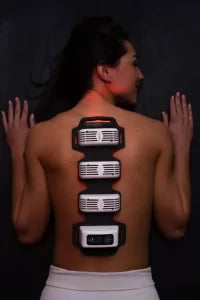
The FlexBeam is a wearable red light therapy device engineered by Recharge Health in Norway. Instead of standing in front of a large panel, you strap this unit directly onto your body, allowing targeted, hands-free treatment of specific joints and muscle groups.
Many consumer devices lack the power to reach deeper tissue. When testing this device, I measured its output at 110 mW/cm². This power density reaches the therapeutic window required for cellular changes. Dr. Zulia Frost developed this unit using NASA-derived research, and it is now used by athletes worldwide.
The clinical science of red light therapy
I review clinical data before recommending any physical protocol. Photobiomodulation (PBM) stimulates cytochrome c oxidase inside your mitochondria, increasing ATP (cellular energy) production and starting several physiological processes:
- Reduced Inflammation: PBM modulates inflammatory pathways to reduce swelling.
- Improved Circulation: It promotes vasodilation, delivering oxygen while clearing metabolic waste.
- Accelerated Tissue Repair: Higher cellular energy supports faster repair of muscle and connective tissue.
A comprehensive review published by Hamblin details these mechanisms and their impact on cellular function (Hamblin, 2017). Clinical trials also demonstrate improvements in musculoskeletal pain management (PMC9980499) and knee osteoarthritis pain reduction (PMC10531845).
The FlexBeam uses 622nm red light for superficial tissue repair and 814nm near-infrared (NIR) light for deep muscle and joint penetration. For more background on the science, see my guide on photobiomodulation explained.
FlexBeam specifications and features
Here is a breakdown of the technical specifications:
| Feature | Specification |
|---|---|
| Wavelengths | 610-650nm (red), 800-850nm (NIR) |
| Peak Wavelengths | 622nm (red), 814nm (NIR) |
| LED Configuration | 3 pods × 3 LEDs = 9 total |
| Max Power Density | 110 mW/cm² |
| Total Optical Power | 5.5W |
| Penetration | Red 2.5cm, NIR up to 10cm |
| Programs | 3 preset programs (10 min each) |
| Battery | Lithium-ion, 5-8 sessions per charge |
| Weight | 0.775kg (1.7 lbs) |
| Warranty | 5 years |
Why I recommend FlexBeam to patients
Patients often tell me their pain returns a few days after manual therapy. I look for tools they can use at home to maintain clinical progress between visits. The FlexBeam delivers a therapeutic dose that supports this consistency.
Who benefits most from the FlexBeam:
- People with persistent lower back or neck pain who need daily relief
- Athletes looking to speed up muscle recovery and reduce post-workout soreness
- Individuals recovering from joint injuries or surgeries who need targeted tissue support
- Desk workers dealing with repetitive strain and postural stiffness from long hours seated
The FlexBeam can be used on multiple body areas including back, shoulders, and joints
Targeted treatment protocols
FlexBeam for Back Pain Lower back pain is one of the most common complaints in my clinic. Research shows laser photobiomodulation outperforms ultrasound therapy for chronic nonspecific low back pain (Lasers Med Sci, 2019). The 814nm NIR wavelengths penetrate deep lumbar muscles and discs. I advise patients to position the FlexBeam horizontally across the lower back using Program 2 for 10 minutes daily.
FlexBeam for Knee Pain Knee osteoarthritis responds well to targeted light therapy. A meta-analysis of 88 trials confirmed low-level laser therapy effectively reduces knee osteoarthritis pain (Brosseau et al., 2000). The flexible pods wrap around the knee joint, delivering light directly into the joint capsule to relieve swelling.
FlexBeam positioned on the knee joint for targeted treatment
FlexBeam for Neck Pain Forward head posture frequently creates chronic cervical tension. The FlexBeam drapes across the posterior neck and upper trapezius muscles. I recommend starting with Program 1 for comfort while treating postural strain. Never use the device directly over the anterior throat or thyroid gland.
FlexBeam can be positioned across the posterior neck and upper trapezius
FlexBeam vs Kineon: clinical comparison
Patients frequently ask me to compare the FlexBeam and the Kineon Move+ Pro. Both are capable devices that serve different rehabilitation needs.
| Feature | FlexBeam | Kineon Move+ Pro |
|---|---|---|
| Light Technology | LEDs only (Red + NIR) | LEDs + Laser diodes |
| Total Power Output | 5.5W (16x more powerful) | ~0.34W |
| Treatment Area | Larger coverage | Smaller, focused |
| Best For | General wellness, larger areas | Specific joint pain |
| Warranty | 5 years | 2 years |
Who is this for? I recommend the FlexBeam for patients who need versatility across larger body areas like the back or shoulders. I recommend the Kineon for patients with highly localized joint pain, such as a single finger or elbow joint.
Is the FlexBeam worth the investment?
At $549 USD, this is a clinical-grade personal tool. Professional in-clinic red light therapy sessions often cost up to $100 each. Daily home use of the FlexBeam drops the per-session cost significantly over its 5-year lifespan, providing strong value for consistent users.
Pros and cons
Based on clinical testing, here are the primary advantages and limitations:
Pros
- 110 mW/cm² delivers a verified therapeutic dose.
- 622nm and 814nm wavelengths are supported by clinical literature.
- Hands-free wearable design makes daily treatments straightforward.
- 5-year warranty provides long-term coverage.
Cons
- Initial purchase cost requires an upfront budget.
- Daily users will need to recharge the battery every few days.
- Results depend on regular, consistent application.
Patient feedback and reviews
Beyond my own clinical observations, the FlexBeam holds a 4.7/5 rating on Trustpilot. Users report noticeable pain relief and improved mobility:
- "I already noticed pain relief within a week use on a very chronic long time lower back pain. Also increased energy and mood change." (Verified Buyer)
- "I am a physical therapist with more than 25 years experience... I've only been using it for a month and have seen significant improvement." (Physical Therapist)
The FlexBeam device and accessories
Final clinical recommendation
I recommend the Recharge Health FlexBeam for home rehabilitation. Its power specifications and targeted wavelengths deliver practical pain relief. Used consistently for back, knee, or neck pain, it actively supports recovery and complements manual therapy work.
Related clinical resources
- Read my full review of the best red light therapy panels for panel comparisons.
- Check out my comparative analysis on the Hooga Red Light Therapy Reviews.